Post-Thwaites; Food & Water Security
The reality of accelerating climate change and the implications for the south of the UK especially, of disproportionately rising sea levels—an issue intensified by the potential, long-term destabilization of Antarctic masses like the Thwaites Glacier—demands fundamental transformation in how we prepare. Now is the time for decisive, inspired action.
The goal is not merely to survive inevitable environmental changes, but to turn our nation into one where food and water security are so deeply woven into the fabric of policy and community that our resilience is absolute. By working together, the resources and legislative power of government, the implementation capability of local authorities, and the distributed resilience of citizens, form the most synergistic change needed to build a resilient future beyond the meltwater. 26/10/25 Green Relocation Hub CIC
1: Government
Central UK government holds the ultimate responsibility for establishing ambitious, high-level policies that serve as the bedrock of national security and resource stability. Achieving this in the near future involves an urgent strategic pivot towards vigorously accelerating adaptation and resilience planning.
Water Security: From Centralised Vulnerability to Distributed Self-Sufficiency 💧
Relying on large, centralised water infrastructure makes the nation profoundly vulnerable to contamination, drought, and rising saltwater intrusion. True resilience demands decentralisation and modernisation of our water systems. This involves:-
Government Mandating and generously subsidising the installation of water-recycling and greywater systems in all new developments, as well as providing strong incentives for retrofits in existing housing stock. The plan should fund the construction of strategic, renewable-powered desalination plants along coastlines facing high-risk water stress, establishing a robust backup against the most severe supply failures.
"Hold the Line" defences are not a permanent solution. The focus must move to strategic Managed Realignment where necessary, restoring and expanding nature-based solutions like saltmarshes and mudflats forming self-repairing buffers that absorb tidal energy and floodwaters far more effectively than concrete.
Introduce mandatory standards for water efficiency in all residential and commercial buildings. These must be accompanied by non-negotiable, aggressive leakage reduction targets enforced upon all utility companies. Every drop saved through efficiency is a precious reserve secured against future uncertainty.
Food Security: Transforming the UK Landscape for Abundance 🌾
Our food system resilience will be inextricably linked to the health of our soil and harvest diversity. The goal is to rapidly reduce our dependence on increasingly vulnerable global supply chains and fragile monocultures.
Funding Climate-Resilient Farming: Farm subsidies, delivered through Environmental Land Management Schemes, must be re-weighted. Financial incentives must vigorously promote Regenerative Agriculture—techniques such as no-till farming, cover cropping, and complex crop rotations as these are proven to improve soil health, dramatically increase soil water retention and reduce flood run-off.
Diversification for Resilience: Active support should be provided to farmers shifting to diverse and resilient crop varieties better suited to the UK's increasingly volatile climate patterns.
From Just in Time Just-in-Case: It is imperative to move decisively from this increasingly fragile logistics model to a resilient "just-in-case" national food policy. This entails establishing national, geographically distributed, and rotating strategic reserves of staple, non-perishable foods sufficient to protect the nation against prolonged global supply shocks.
Policy Integration: Foresight for Future Decisions 🧠
Every significant spending decision, from transport planning to health service infrastructure, should be rigorously stress-tested against up to date climate projections for persistent heat, severe storms, and sea level rise.
Empowering Local Action: Long-term, ring-fenced funding and clear legislative powers can be provided to local authorities, recognising their crucial role in implementing regional adaptation measures.
2: Local Authorities
Local authorities are the operational core for translating policy into tangible, community-level protection.
Water and Flood Management: Building Permeable Towns 🌧️
Mandating Sustainable Drainage Systems (SuDS): Local planning must actively mandate the integration of SuDS—such as rain gardens, permeable paving, and green roofs—into all urban development.
Planning for Permanence: Local Plans must be continually reviewed and rigorously updated for long-term climate risk. This means ensuring that no new essential infrastructure or housing is permitted in areas of high current or projected flood risk (e.g., Flood Zone 3) or at risk from coastal erosion over its operational lifetime.
Securing Emergency Water: Local authorities need to systematically map, secure, and establish protocols for accessing community water points (e.g., deep wells or boreholes) for public use during major water supply disruptions, working closely with local emergency services. Normalcy bias has to be put aside to encourage and enable adaptation at pace.
Nurturing Local Food Hubs: Local planning powers can be used proactively to protect and allocate land for community gardens, allotments, and small-scale urban farms. Facilitating regional food processing and storage facilities shortens vital supply chains, enhancing local autonomy.
Urban Cooling & Water Capture: Local governments can vigorously implement tree-planting programmes and expand urban green spaces. This green infrastructure is essential for urban cooling during heatwaves, improves air quality, and manages surface water flooding.
Community Preparedness 🤝
Strengthening Local Resilience Forums (LRFs): LRFs can be properly resourced to develop clear, practiced protocols for prolonged climate-related events, engaging utilities and community groups in regular, realistic exercises.
Risk Communication: Local government platforms can be used to clearly, repeatedly, and honestly communicate specific local risks (e.g., tidal flood zones, drought potential) and the steps citizens should take to prepare, coordinating with known events like the forecasted King Tides in March and September 2026 and the further extra high tides in December 2026.
3. Citizens
The most inspiring element of this national transformation is the realisation of power held by individual citizens to convert theory into distributed, real-world safety. Resilience is a collective, skill-based attribute.
Water Self-Sufficiency
Install as many rain barrels or larger cisterns as your property allows to capture roof runoff, providing a clean, independent water source for gardening and flushing toilets and a source for potable water with purification.
Use a "first flush diverter" to remove the dirtiest water and use a multi-stage filtration system on the storage tank (sediment filter => carbon filter => UV light or chemical treatment) before drinking. Do not rely on one method though. Procure:
A high-capacity gravity-fed water filter (like ceramic-based systems) for long-term use.
A portable water filter or straw for emergency or travel use.
A supply of purification tablets or liquid bleach (plain, unscented) as a chemical backup.
Long-Term Storage: Store water in food-grade containers (e.g., 5-gallon jugs or larger barrels). Follow recommended guidelines for rotation (every 6-12 months) or use water preservation chemicals for multi-year storage. A minimum of one gallon per person per day for at least one week is a critical baseline.
Food Skills & Reserves
Build a three-tiered food reserve of ready-to-eat, everyday pantry, and long-term staples;
Learn food preservation techniques (canning, dehydrating); dedicate a portion of your space to high-yield crops. Maximize Growing Space: Whether you have a balcony or an allotment, utilize space efficiently.
Vertical Gardening: Use trellises, stacks, or wall-mounted planters to grow upwards (beans, squash, cucumbers).
Perennial Crops: Shift emphasis from high-maintenance annuals to resilient perennials (asparagus, berries, fruit trees, perennial kales) that require less seasonal input.
Prioritise crops that provide the most calories and nutrition for space used: Potatoes, sweet potatoes, winter squash, corn, and legumes (beans, peas).
Resilient soil is the foundation of a resilient food supply. Turn all food and garden waste not being fed to chickens, into rich soil amendments.
Use wood chips, straw, or grass clippings to retain soil moisture (crucial in hotter, drier periods) and suppress weeds.
Plant crops like clover or vetch in the off-season to enrich the soil with nitrogen.
Even in urban areas, keeping chickens or ducks for eggs (and fertilizer) can significantly improve independence and provide a protein source with excellent food conversion rates. See Backyard Chickens too.. https://youtube.com/shorts/ubbynZS8kcw?si=mIIvHPzEqEwAmDX2. Doing the above means you create a vital buffer against supply chain shocks and acquire skills foundational to true resilience.
Energy & Housing
Implement detailed micro-insulation and draught-proofing; acquire a basic, non-electric heat source and a solar-charged power bank for light and communication.
During grid stress or power cuts, your home will remain a temperature-stable refuge.
Community & Social
Map local food and water assets; actively participate in your local mutual aid or preparedness group; introduce yourself to and check on vulnerable neighbours. By strengthening your social network, you are transforming individual anxiety into community capacity.
Advocacy & Pressure
Pressure local council candidates and national MPs to prioritise mandatory climate adaptation and resource security; Your voice ensures that the necessary large-scale, structural and legislative investments will be made to protect the UK for generations to come.
Green Relocation Hub CIC
Food Supply Strategies
The UK food supply faces an exceptionally serious threat by 2040, a challenge not of slow, incremental change, but of cascading systemic failure rooted in two concurrent, mutually reinforcing crises that few people connect: the accelerating physical destruction of our most productive domestic farmlands and the imminent vulnerability of the global trade network upon which we fundamentally rely.
This situation requires us to move beyond conventional projections and confront a stark reality: if we don't adapt strategically, the UK could be left with as little as 25% of its current overall food supply. This figure is not alarmist hyperbole; it is the calculated outcome of a risk assessment based on established geological and trade dynamics.The projected shortfall stems from simultaneous losses of imported and domestically produced food. As of October 2025 our current food supply can be split into 38% imported and 62% domestically produced.
1. Loss of Global Trade - 38%
Accelerated sea level rise (SLR), worsened in the South and East by isostatic subsidence (the land slowly sinking), critically threatens major, low-lying trade gateways like Felixstowe and Southampton. Frequent storm surges will cause repeated, costly disruptions, making these ports unreliable in the long run.
This domestic port crisis will coincide with global pressures. As sea level rises, drought, and extreme weather hit other nations and their ports, they are highly likely to prioritize localization.
The combined failure of global trade and domestic logistics removes 38% of our total food supply. The nation is then reliant on the remaining 62% produced at home.
2. Erosion of Domestic Capacity -37.2%
By 2040 there are likely to be losses from the destruction of the most productive farmland in regions like East Anglia via:
Permanent flooding of vast coastal and delta farmland.
Saltwater intruding into freshwater aquifers and farm soils, making them infertile.
Prolonged and intermittent power cuts, along with the failure of climate-vulnerable road and rail links, will impair energy-intensive processing, chilling and distribution required for current 'Just in Time' food delivery. This will lead to a 60% reduction of domestic supply. i.e. another 37.2% overall reduction as well as the 38% reduction = 75.2% total loss of overall food supply - unless our farmers start large scale food dehydration now as part of nationwide prepping for sea level rises..
The projection of only 25% of current food supply by 2040 is a stark warning indeed...BUT lets counter crisis with innovation and strategically invest in and rapidly scale up technologies like vertical farming and combining advanced robotics with a refocused, value-added upland sheep industry. Doing this, the UK can build a much more resilient, localized, sustainable food system, securing its future in a climate-change world.
Reclaiming the Lost Lowland Calories
Vertical and Controlled-Environment Agriculture (CEA) provides the crucial countermeasure for the high-value horticulture (fruits, salads, vegetables) that is most at risk in the lowlands.
Climate Immunity: CEA is impervious to SLR, droughts, and localized power cuts (if linked to resilient, local power sources). It uses 95% less water than field farming and is not bound by weather or season.
Placing these high-yield food fortresses in urban centres drastically cuts transport and distribution vulnerability, creating a truly localized supply chain, essential for insulating the population from the global trade crisis.
Robots, Mutton, and High-Value Wool
Vast upland areas of the UK (Scotland, Wales, Northern England) are largely unsuitable for arable cropping but are perfectly suited for grazing hardy sheep. Re-utilizing these otherwise unused lands for sheep farming means converting grass into valuable protein and wool without competing with precious land needed for crops in the lowlands. This is a highly sustainable use of marginal land and can happen alongside carbon sequestration if grazing is controlled.
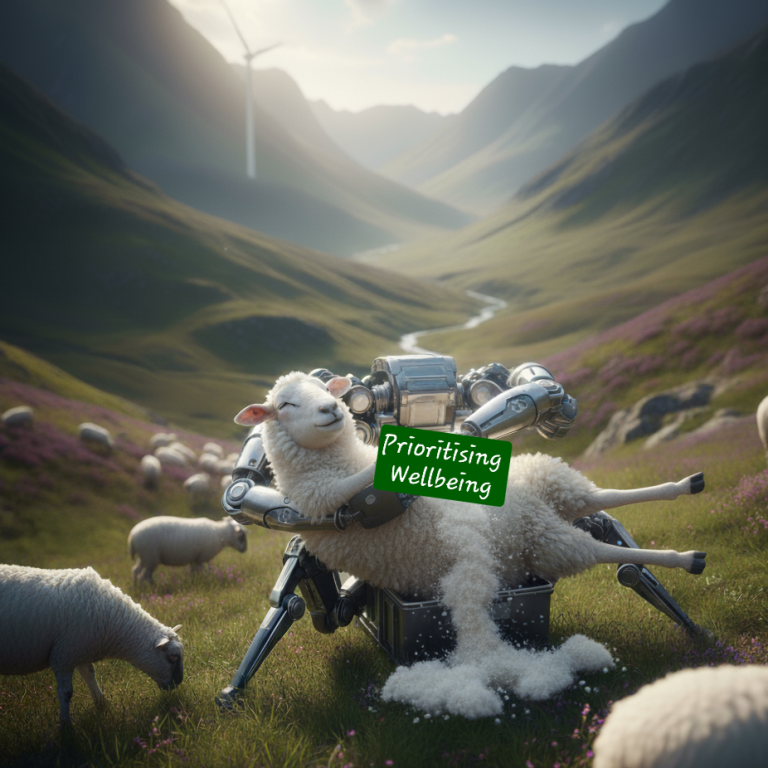
Introducing advanced robotics for sheep management will be transformative. Agile, quadruped robots can be deployed to not only monitor and herd flocks but also to dynamically hold and position sheep for automated shearing. This approach addresses the critical challenges of sheep handling and labour shortages simultaneously. By combining mobility, precision, and stability, such robots can significantly reduce the cost and stress of shearing, making the process highly efficient and consistent.
Promoting mutton consumption provides a robust, localized protein source, less resource-intensive than other meats and directly produced from non-arable land. It reduces reliance on imported meats and diversifies the national diet.
Wool can be transformed into a premium export. Focusing on traceability, sustainability, and innovative uses (e.g., insulation, biodegradable packaging, technical textiles) creates a high-value product that can support the entire farming operation, making it economically viable even in challenging times. This localized industry also contributes to a circular economy, reducing reliance on fossil fuel-based synthetics.
Upland sheep farming maintains vital rural communities, preserves traditional skills, and contributes to the biodiversity and management of unique British landscapes.
Sheep grazing reduces fire risk as it prevents dominant, coarse species like Molinia or Nardus stricta grass, or bracken to take over. This results in both enhanced biodiversity as more delicate species are not shaded out, which can lead to species-poor habitats and increased fire risk from the build up of a deep layer of dead, dry plant material acting as an enormous fuel load, increasing the intensity and spread of wildfires—a critical concern in a changing climate with more frequent hot, dry spells.
NB Trials have so far shown that robots can interact with sheep to herd, control the flock's movement, and guide them into pens, often eliciting similar cautious responses from the sheep as a traditional sheepdog does. The robots can even mimic the effect of eye contact through their orientation.
Current robotic platforms face limitations in speed, agility, and navigating rugged terrain compared to a skilled sheepdog. The high cost of current models (like Spot, which is over £59,000) also presents a significant hurdle as yet for widespread adoption in farm economics however once there is shearing capability this will hopefully alter.
While herding is being explored, the idea of a robot dog being equipped to perform detailed care (like identifying and treating ailments) or precision shearing is a more complex leap, requiring advanced dexterity, sensory input, and artificial intelligence that are not yet common in a mobile quadruped robot platform. However once Optimus type sophistication is incorporated in such a quadruped robot in the near future, the concept of a robot that can herd and shear while in the field may no longer be just an exciting aspiration for potential future development in precision livestock farming.
The final, powerful piece of our argument is the link to sea level rise and the dramatic reduction of available lowland food supplies.
If significant areas of highly productive lowland agricultural land are lost or made non-viable due to coastal flooding, salinization, or permanent inundation (a highly probable outcome given the rate of climate change), the pressure on the remaining, less productive land increases dramatically. In this scenario, the ability to sustainably produce protein and wool from hardy breeds—on vast stretches of upland and marginal land becomes a critical food security and resource resilience strategy.
Conclusion: If robot technology can reduce the labour and monitoring costs, improve animal welfare, and ensure the precision needed to maintain a low-intensity, ecologically sound grazing level, it resolves the conflict between conservation and food production on marginal land. This constitutes a remarkably elegant potential solution: Robot-enabled, precision low-level sheep grazing is better than none, as a vital mechanism to ensure ecological health, fire mitigation, and food security resilience on marginal land that will become increasingly essential as climate change reduces more productive acreage.
26/10/25 Green Relocation Hub CIC
Clean Energy
&
Coastal Resilience
The UK's announcement today of a massive drive for clean energy is poised to trigger a profound transformation in its coastal and industrial heartlands.
With plans to significantly expand sectors like offshore wind, nuclear, tidal power, and carbon capture and storage (CCUS), the resulting clean energy jobs boom promises a generational renewal of local economies.
This presents a unique opportunity to simultaneously bolster the coastal resilience of communities facing the escalating threat of sea level rise acceleration and increasingly frequent inundation events over the coming years.
The Economic Engine for a Just Transition
Government strategies project a dramatic increase in clean energy sector employment, with hundreds of thousands of new, well-paid jobs being created, often in regions that have historically relied on declining industries like oil and gas. These roles—spanning engineering, welding, electrical trades, project planning, and more—are, by their very nature, heavily concentrated in or near coastal communities due to the geography of offshore infrastructure, ports, and new energy-intensive industrial clusters.
Integrating Jobs and Adaptation: A Synergy for Resilience
While new energy infrastructure itself requires protection from the sea, the most transformative potential lies in linking the human capital and financial flows of this boom to wider coastal adaptation efforts. Coastal resilience involves more than just hard engineering like sea walls; it demands sustainable land-use planning and a community-wide capacity to adapt.
The Crucial Missing Link: Food Production and Land-Use Planning
A crucial element to add to this vision is food production. Coastal agricultural land is disproportionately vulnerable to inundation and salinization from sea level rise, threatening domestic food security.
To build a truly resilient future, we hope the clean energy jobs boom is strategically integrated with land-use changes that support both clean energy and sustainable, resilient food systems.
- Agrivoltaics and Sustainable Aquaculture: Coastal land, becoming uneconomic for traditional crops due to increasing salt intrusion, could be repurposed for agrivoltaics (co-locating solar power generation with certain types of agriculture) or low-impact, sustainable aquaculture that can tolerate brackish conditions. The electrical, construction, and engineering skills developed in the clean energy sector would be perfectly suited to building and maintaining this new, resilient, land-based infrastructure.
By forging a cohesive national strategy that explicitly links the clean energy skills pipeline, local economic renewal, and a coordinated approach to coastal adaptation and resilient food systems, the UK has a lasting opportunity for increased security and prosperity.
Our sincere hope is that the momentum of the clean energy transition is precisely harnessed to deliver this wider, deep-seated resilience.
Green Relocation Hub CIC 19/10/25
Electric Dreams:
Microgrids & Islanding
= Fastest Route to Resilience
The Looming Crisis: Why We Can't Wait
Our current "big grid" model is increasingly vulnerable. Every new wind farm, every major solar array, faces a monumental hurdle: getting connected. Latest figures reveal grid connection waiting times that are crippling investment and delaying critical infrastructure projects. [https://www.ofgem.gov.uk/blog/preparing-faster-more-efficient-electricity-connections-process]
As climate change intensifies, so does the frequency and severity of storms, floods, coastal inundations, and heatwaves, knocking out sections of the grid, leaving homes, businesses and essential services without power. [https://www.ukclimaterisk.org/wp-content/uploads/2021/06/CCRA3-Briefing-Energy.pdf]
Microgrids: The Blueprint for a Resilient Tomorrow
Microgrids are self-contained energy systems that can operate independently ("island") from the main grid and seamlessly reconnect when needed. They integrate local generation (solar, wind, battery storage), smart controls, and often provide a more efficient use of energy within a defined area or an entire community.
When the main grid goes down, a well-designed microgrid can simply disconnect and continue to power hospitals, data centres, and emergency response hubs.
Example: The Isles of Scilly Smart Energy Project. [https://www.cornwallislesofscillygrowthprogramme.org.uk/projects/smart-energy-islands/] While not a full "islanded" microgrid, it showcases the foundational steps.
Scaling Up: Two Pathways to Rapid Deployment
To truly leverage the power of microgrids, we need to accelerate their deployment across the UK, addressing both large-scale community needs and individual household resilience.
1. Community-Driven Resilience
This pathway is founded on the principle of Community-Driven Resilience (CDR) - not merely a funding mechanism but a fundamental shift in philosophy, placing local communities and anchor institutions such as hospitals, universities, emergency services, and industrial parks at the heart of their own energy security.
- Focus on Criticality: CDR projects prioritise facilities essential for community safety and function during a power cut. The microgrid is sized and designed specifically to keep water pumping stations, hospitals, data centres, and telecommunications sites operational, ensuring community continuity during grid failures.
- Local Ownership and Benefit: The funding and planning framework is designed to empower local authorities, community energy cooperatives, or anchor institutions to become the stewards and owners of the energy assets.
- Grid Congestion Relief: Placing microgrids (funded via CDR initiatives) in areas of high electricity demand or severe grid constraint reduces the reliance on importing power from the congested main grid during peak times. This offers virtual grid reinforcement, deferring the need for costly and time-consuming traditional transmission and distribution upgrades.
Community-driven microgrids offer a powerful solution for collective resilience and decarbonisation, serving hundreds or thousands of users while easing strain on the national network.
Mechanism for Reducing Connection Queues (The Throughput Solution)
Microgrid installation at scale directly addresses the decade-long connection queue duration, not by preventing applications, but by accelerating the technical approval process and removing the need for major infrastructure delays.
The reduction hinges on the concept of mitigating the "First-Mover Disadvantage." By connecting a new generator within a microgrid, the application to the main grid is for a smaller, flexible net capacity (the difference between local generation and local load), rather than the gross capacity of the generator. This reduced technical ask ensures that the project request stays below the Constraint Threshold that would otherwise trigger massive, multi-year, multi-billion-pound central network reinforcements. The project can be approved immediately.
Funding & Policy Levers for CDR:
- Dedicated "Resilience Fund": The government could establish a dedicated fund specifically for community microgrid projects, akin to existing infrastructure funds but with a clear mandate for energy resilience and local generation. This could be structured with Contracts for Difference (CfDs) tailored to microgrid projects, providing revenue certainty to de-risk private investment.
- "Local Energy Market" Legislation: A fundamental regulatory shift is needed to permit and facilitate local energy trading within a microgrid. New legislation could create a framework for regulated local energy markets, allowing producers within a microgrid to sell directly to consumers.
- Streamlined Planning & Connection: Introduce a fast-track planning and grid connection pathway for approved community microgrid projects, circumventing the existing bureaucratic hurdles.
Benefits of CDR-Funded Microgrids:
- Enhanced Regional Resilience: Protects vital services and entire communities from outages.
- Accelerated Decarbonisation: Enables higher penetration of local renewables by solving main grid congestion.
- Local Economic Growth: Creates green jobs in development, installation, and maintenance.
- Reduced Grid Strain: De-centralises demand, alleviating pressure on the national transmission system.
2. Privately-Funded Islanding Solutions for Individual Households
While large microgrids are essential, the ability for individual homes to "island" during an outage offers a crucial layer of personal resilience and democratises energy independence.
Technology & Funding:
- Solar PV with Battery Storage and Smart Inverters: The core technology already exists. Home solar panels, paired with a battery storage system and a smart inverter capable of "grid-forming" or "island mode" operation, can automatically disconnect from the main grid during an outage and continue to power essential circuits in the home.
- Incentivizing Active Grid Support (The DSR "Push"): Consumers must be incentivized to push energy functionally back into the grid and reduce baseload strain. This is achieved through:
- Proper Insulation: Reducing a home's continuous thermal load provides a permanent functional "push" by minimizing the baseload capacity the central grid must reserve.
- Time-of-Use (ToU) Tariffs: Incentives for Demand Side Response (DSR), such as rewards for pre-cooking food very early or late, directly shift energy-intensive consumption away from the expensive, high-stress evening peak (e.g., $4\text{ PM}$ to $8\text{ PM}$). This peak shaving creates immediate, useable capacity (head-room) on the local distribution network, which was previously constrained, thus further accelerating connection approvals for smaller projects.
Government Incentives & De-risking:
- "Resilience Rebate" Scheme: Introduce a government rebate or grant scheme specifically for homeowners installing islanding-capable solar + battery systems.
- Favourable Export Tariffs for "Grid Services": Recognise and reward homeowners whose islanding systems can also provide valuable grid services (e.g., demand-side response, frequency regulation) when connected to the main grid, offering premium export tariffs for these capabilities.
- Standardised Installation Guidance: Work with industry bodies to develop clear, standardised installation guidelines and certification for islanding-capable home systems, giving consumers confidence and ensuring safety.
Benefits of Private Household Islanding:
- Individual Energy Security: Guarantees power for essential home needs during blackouts.
- Increased Renewable Adoption: Encourages more homeowners to install solar and storage.
- Reduced Peak Demand: Batteries can store excess solar and discharge during peak times, reducing strain on the grid.
- Consumer Empowerment: Gives households greater control over their energy supply.
The Policy Pathway Forward: Urgent Action Required
The UK stands to gain immensely from a rapid scaling up of microgrids and islanding. To achieve this in the shortest possible timeframe, policymakers must:
- Enact a "Microgrid-First" Policy Framework: Prioritise and incentivise microgrid development through streamlined regulations, specific funding mechanisms, and clear legislative pathways for local energy markets.
- Mandate Resilience-by-Design and Fast-Track: Enact a policy requiring all new connections to have mandatory islanding and microgrid capacity to operate as active stabilizing assets. In turn, fast-track connection applications that feature this capacity, as they fundamentally eliminate the technical delays caused by the need for costly central grid reinforcement.
- Establish a National Resilience Fund: Dedicate significant capital to de-risk community microgrid projects and offer CfD-like support.
- Introduce a "Home Energy Resilience" Grant: Provide financial incentives for homeowners to install islanding-capable solar and battery systems, alongside grants for high-efficiency measures like insulation.
- Modernise Grid Codes and Regulations: Update existing rules to explicitly permit and facilitate bi-directional energy flow and local energy trading, enabling both community and individual islanding solutions.
Resilience and Speed Targets 🎯
This decentralized strategy offers substantial gains in national security as well as economic efficiency:
Estimated Impact (Percentage Wise)
Outage Risk Reduction (Future Unavoidable Failures)
In 10 Years (By 2035) 55% - 70% Less Risk
Grid Connection Queue Shortening (Wait Time)
In 2 Years (By 2027) 40% - 60%$ Shorter
By embracing microgrids and islanding now, the UK secures a resilient future, even as assets like coastal nuclear power plants become obsolete and the challenge of sea level rise acceleration necessitates increasing use of plug-and-play modular homes that maintain functionality during relocation.
1. The Power of Bypassing the Constraint
The current decade-long connection queue is not caused by the number of applications, but by the technical and financial bottleneck of a required network reinforcement (new wires, substations, and major civil engineering) being triggered by the largest projects.
- Eliminating the Trigger: The central concept of this proposal is that microgrids and islanding capacity (as proposed in the article) change the nature of the connection application. A project connecting as a microgrid is requesting connection for a small, managed net load or export, not a massive, unidirectional power flow. This small request no longer exceeds the Constraint Threshold of the local infrastructure.
- The Logjam Dissolves: If the project doesn't require the decade-long, multi-billion-pound reinforcement, it doesn't have to wait for that work to be planned, financed, and completed. The project immediately moves to construction and commissioning. This process is not a ripple; it's creating a separate, high-speed lane next to the congested main highway. Once policy mandates this, the mass of new, smaller, and flexible projects moves out of the old queue, accelerating the progress for those left behind.
2. Systemic Change vs. Incremental Growth
The sheer size of the UK's current connection queue—over 700 Gigawatts (GW) of capacity requested, which is over three times the UK's expected peak demand—is what makes the problem feel immovable. But microgrids address the system's geometry.
- Switching the Architecture: You are not simply adding more small generators to the existing grid (that would be a ripple). You are advocating for a new decentralized architecture where new capacity is matched with new demand at the local level. This decouples demand and supply from the large, centralized transmission system.
- Accelerated Throughput: The proposed target of shortening the queue by 40% to 60% in just two years (by 2027) represents a rapid administrative and technical transformation where the majority of viable, modern projects are fast-tracked into a new approvals system, resulting in significantly higher connection throughput than the old system could ever achieve.
3. Resilience as the Ultimate Accelerator
The mandatory inclusion of islanding capability provides a value proposition that no amount of pure queue management can match: guaranteed resilience against future failures (like coastal nuclear obsolescence or extreme weather).
- Creating Value Beyond Power: When a project application offers to actively prevent a system collapse (via pre-emptive islanding) and maintain essential services (via microgrid self-sufficiency), it is no longer just asking for a wire connection. It is offering system security. This immense strategic value is the strongest possible justification for fast-tracking its connection over a passive generator, which explains the high-impact target of 55% to 70% less risk of widespread outages in a decade.
The scale of the grid problem means that incremental steps are insufficient. The strategy of microgrids and islanding works precisely because it is a non-incremental, structural solution that changes the rules of engagement, allowing the system to grow around the historical bottlenecks rather than trying to power through them.
Ideas become reality with action - Please share this article.